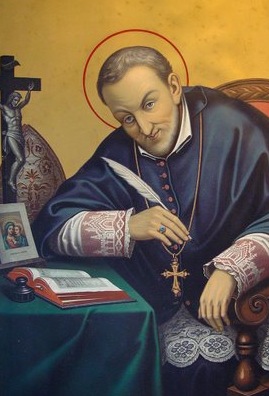
Oct 20, 2012

What must we do to be truly called Catholic?


And so now is the time that having being filled with all of the theoretical knowledge about the realities of the Catholic Church and Faith and its necessity for salvation we will now turn to practical matters.  What follows is a list of essential practices which are a natural outgrowth of what we believe in our hearts as Catholics, the truth of Jesus Christ, and a way of showing forth Christ in our own person:

-Hold fast to all of the true teachings of the One, Holy, Catholic, and Apostolic Church.

-Frequent the Sacraments of Penance and the Eucharist

-Follow all Six of the precepts of the Church:
1- To attend Mass on Sundays and holydays of obligation
2- To fast and abstain on the days commanded.
3- To confess our sins at least once a year.
4- To receive the Blessed Eucharist at Easter or within the time 
approved.
5- To contribute to the support of our Pastors.
6- Not to solemnize marriage at the forbidden times; nor to marry persons within the forbidden degrees of kindred, or otherwise prohibited by the Church, nor secretly.

-Devote your life to serving and loving the most Sacred Heart of Jesus and the most Immaculate and Sorrowful Heart of Mary in whatever state of life God has called you to.

-Set aside at least 15 minutes each day for Mental Prayer

-Make a good morning offering every Day

-Pray at least 5 decades of the Rosary every day, and join the Archconfraternity of the Most Holy Rosary.

-Pray 3 Hail Mary’s every morning and every night for holiness and a happy death.

-Wear the Brown Scapular (or better yet the Five-fold Scapular) and be enrolled in it.

-Perform the Spiritual Works of Mercy
  • To instruct the ignorant;
  • To counsel the doubtful;
  • To admonish sinners;
  • To bear wrongs patiently;
  • To forgive offences willingly;
  • To comfort the afflicted;
  • To pray for the living and the dead.
-Perform the Corporal Works of Mercy
  • To feed the hungry;
  • To give drink to the thirsty;
  • To clothe the naked;
  • To harbour the harbourless;
  • To visit the sick;
  • To ransom the captive;
  • To bury the dead.

13 Essential Means to attaining Salvation
 (Compiled by Father John Fongemie, F.S.S.P., and based upon Father Reginald Garrigou-Lagrange’s “The Priest in Union with Christ” and Dom Chautard’s “The Soul of the Apostolate”)

-Have a great desire for Holiness, “Be you therefore perfect, as also your heavenly Father is perfect.” –Matt 5:48

-Conformity to the Will of God and abandonment to Divine Providence and to follow the Vocation God will’s for us.

-Fidelity to the Graces we receive each day and a devotion to the Holy Ghost

-The practice of the presence of God, i.e. Jesus in the Eucharist and the Blessed Trinity in our Souls when we are in the State of Grace.  Attending daily Mass, making spiritual communions, praying the Rosary, etc.

-Examination of conscience each day.

-Frequent Confession.

-External and internal mortification

-Willingness to makes sacrifices.

-Plan of life.  Living a timetable each day that makes time for prayer.

-Spiritual Reading, reading of good and holy Catholic books according to our state in life and aptitude.

-Spiritual Direction.  Everyone needs regular spiritual director, which means getting a good spiritual director.

-Good friendships.  Meaning making friends with those who are trying to live good and holy lives.

-Mental Prayer.  “Every Saint, became a Saint, because of mental prayer.” –Saint Alphonsus Liguori

Can the Church’s Dogmatic teaching change?


Many might object to the many sources I have cited throughout this article thus far.  They think that “well that was the old days” and that “things have changed now”, but actually they haven’t and they can’t.  What the Catholic Church actually teaches is that it teaches the one truth given to us by Jesus Christ and which is unchanging.  No one in the Church, not even a Pope, has the authority to change anything that has been set down under the guarantee of Infallibility and bearing the title of Dogma.

Three Basic Principles:

#1 - God can't have a new idea. Why? He's God. He already knows everything, can't learn anything, can't forget anything, and he is eternal and unchanging.

#2 - God has made it possible for each one of us to know what is necessary for salvation. How did he do this? He founded the One, Holy, Catholic, and Apostolic Church, which is guided by the Holy Spirit in its Infallible and Dogmatic pronouncements. How do we know that this is so?... 1) If it has been taught always and everywhere by all of the orthodox teachers of the faith (ie. that only men were ever to be ordained Priests), or 2) When an Ecumenical Council Solemnly declares and defines a teaching and does so saying that it is a teaching handed down by the Apostles from our Lord (ie. the Divine Motherhood of Mary), or 3) When a Pope speaks Ex Cathedra (What is "ex cathedra"?) (ie. the Immaculate Conception of Mary).

#3 - Christ founded his Church to pass down His teachings and NOT to add to them or change them in any way.

The Infallible Teaching of the First Vatican Council:

"For the holy Spirit was promised to the successors of Peter not so that they might, by his revelation, make known some new doctrine, but that, by his assistance, they might religiously guard and faithfully expound the revelation or deposit of faith transmitted by the apostles.  Indeed, their apostolic teaching was embraced by all the venerable fathers and reverenced and followed by all the holy orthodox doctors, for they knew very well that this see of St. Peter always remains unblemished by any error, in accordance with the divine promise of our Lord and Saviour to the prince of his disciples: I have prayed for you that your faith may not fail; and when you have turned again, strengthen your brethren [Lk 22, 32]."  (Session 4, 18 July 1870, Ch. 4, #6)


"...that meaning of the sacred dogmas is ever to be maintained which has once been declared by holy mother church, and there must never be any abandonment of this sense under the pretext or in the name of a more profound understanding." (Session 3, 24 April 1870, Ch. 4, #14)

And Pope Paul VI's Encyclical Mysterium Fidei, which was promulgated on September 3, 1965 near the close of the Second Vatican Council only reiterates this teaching...

"There are, however, Venerable Brothers, a number of reasons for serious pastoral concern and anxiety... We can see that some of those who are dealing with this... Dogma...that are disturbing the minds of the faithful and causing them no small measure of confusion about matters of faith, just as if it were all right for someone to take doctrine that has already been defined by the Church and consign it to oblivion or else interpret it in such a way as to weaken the genuine meaning of the words or the recognized force of the concepts involved…And so the rule of language which the Church has established through the long labor of centuries, with the help of the Holy Spirit, and which she has confirmed with the authority of the Councils, and which has more than once been the watchword and banner of orthodox faith, is to be religiously preserved, and no one may presume to change it at his own pleasure or under the pretext of new knowledge."

Is it necessary to be Catholic to be saved?

Many Catholics today object to, or even outright reject, the teaching of “Extra Ecclesiam nulla salus” or “No salvation outside the Church”.  This is very dangerous, however, because this is a defined Dogma of our Catholic faith which we must believe or we cannot be saved. (Fundamentals of Catholic Dogma, Dr. Ludwig Ott, pgs. 312-13)  The following are the official pronouncements through the history of the Church, and for which I have provide complete citations including the paragraph number where it can be found in Denziger’s The Sources of Catholic Dogma:

"By heart we believe and by mouth confess the one Church, not of heretics but the Holy Roman, Catholic, and Apostolic Church outside which we believe that no one is saved."
-Pope Innocent III, Eius exemplo, 18 December 1208 (DS 423)

"The universal Church of the faithful is one outside of which none is saved."
-Pope Innocent III, Fourth Lateran Council, November 1215 (DS 430)

"We declare, say, define, and pronounce that it is absolutely necessary for the salvation of every human creature to be subject to the Roman Pontiff."
-Pope Boniface VIII, Unam Sanctam, 18 November 1302 (DS 468)

“No man of the wayfarers outside the faith of this Church, and outside the obedience of the Pope of Rome, can finally be saved.”
-Pope Clement VI, Super quibusdam, 20 September 1351 (DS 570 b)

"The Most Holy Roman Church firmly believes, professes and proclaims that all those who are outside the catholic church, not only pagans but also Jews or heretics and schismatics, cannot share in eternal life and will go “into the everlasting fire which was prepared for the devil and his angels” [Matt. 25:41], unless they are joined to the catholic church before the end of their lives; that the unity of the ecclesiastical body is of such importance that only for those who abide in it do the church's sacraments contribute to salvation and do fasts, almsgiving and other works of piety and practices of the Christian militia produce eternal rewards; and that nobody can be saved, no matter how much he has given away in alms and even if he has shed his blood in the name of Christ, unless he has persevered in the bosom and the unity of the catholic church.”
-Pope Eugene IV, Council of Florence, Bull Cantate Domino, 4 February 1441 (DS 714)

“Likewise, all other things I accept and profess, which the Holy Roman Church accepts and professes, and I likewise condemn, reject, and anathematize, at the same time all contrary things, both schisms and heresies, which have been condemned, rejected, and anathematized by the same Church. In addition, I promise and swear true obedience to the Roman Pontiff, the successor of Blessed Peter, the prince of the Apostles and the vicar of Jesus Christ. And that this faith of the Catholic Church, without which no one can be saved, etc. . . . [as in the Tridentine profession of faith].”
-Pope Benedict XIV, Nuper ad nos, Profession of Faith prescribed of Eastern Rite Catholics, 16 March 1743 (DS 1473)

"For, it must be held by faith that outside the Apostolic Roman Church, no one can be saved; that this is the only ark of salvation; that he who shall not have entered therein will perish in the flood; but, on the other hand, it is necessary to hold for certain that they who labor in ignorance of the true religion, if this ignorance is invincible, are not stained by any guilt in this matter in the eyes of God. Now, in truth, who would arrogate so much to himself as to mark the limits of such an ignorance, because of the nature and variety of peoples, regions, innate dispositions, and of so many other things? For, in truth, when released from these corporeal chains "we shall see God as He is" [1 John 3:2], we shall understand perfectly by how close and beautiful a bond divine mercy and justice are united; but, as long as we are on earth, weighed down by this mortal mass which blunts the soul, let us hold most firmly that, in accordance with Catholic teaching, there is "one God, one faith, one baptism" [Eph. 4:5]; it is unlawful to proceed further in inquiry. "

-Blessed Pope Pius IX, Singulari Quadem, 17 March 1856 (DS 1647)

"Here, too, our beloved sons and venerable brothers, it is again necessary to mention and censure a very grave error entrapping some Catholics who believe that it is possible to arrive at eternal salvation although living in error and alienated from the true faith and Catholic unity. Such belief is certainly opposed to Catholic teaching. There are, of course, those who are struggling with invincible ignorance about our most holy religion. Sincerely observing the natural law and its precepts inscribed by God on all hearts and ready to obey God, they live honest lives and are able to attain eternal life by the efficacious virtue of divine light and grace. Because God knows, searches and clearly understands the minds, hearts, thoughts, and nature of all, his supreme kindness and clemency do not permit anyone at all who is not guilty of deliberate sin to suffer eternal punishments. Also well known is the Catholic teaching that no one can be saved outside the Catholic Church. Eternal salvation cannot be obtained by those who oppose the authority and statements of the same Church and are stubbornly separated from the unity of the Church and also from the successor of Peter, the Roman Pontiff, to whom 'the custody of the vineyard has been committed by the Savior.'(Ecumenical Council of Chalcedon in its letter to Pope Leo)"
-Blessed Pope Pius IX, Quanto Conficiamur Moerore, 10 August 1863 (DS 1677)

"But when we consider what was actually done we find that Jesus Christ did not, in point of fact, institute a Church to embrace several communities similar in nature, but in themselves distinct, and lacking those bonds which render the Church unique and indivisible after that manner in which in the symbol of our faith we profess: 'I believe in one Church.'...For this reason Christ, speaking of the mystical edifice, mentions only one Church, which he calls His own - "I will build my church;" any other Church except this one, since it has not been founded by Christ, cannot be the true Church...The Church, therefore, is bound to communicate without stint to all men, and to transmit through all ages, the salvation effected by Jesus Christ, and the blessings flowing there from. Wherefore, by the will of its Founder, it is necessary that this Church should be one in all lands and at all times...The Church of Christ, therefore, is one and the same for ever; those who leave it depart from the will and command of Christ, the Lord - leaving the path of salvation they enter on that of perdition."
-Pope Leo XIII, Satis Cognitum, 29 June 1896 (DS 1955)

"Actually only those are to be included as members of the Church who have been baptized and profess the true faith, and who have not been so unfortunate as to separate themselves from the unity of the Body, or been excluded by legitimate authority for grave faults committed. "For in one spirit" says the Apostle, "were we all baptized into one Body, whether Jews or Gentiles, whether bond or free." [I Cor. 12:13] As therefore in the true Christian community there is only one Body, one Spirit, one Lord, and one Baptism, so there can be only one faith. [Eph. 4:5] And therefore if a man refuse to hear the Church let him be considered -- so the Lord commands -- as a heathen and a publican. [Matt. 18:17] It follows that those are divided in faith or government cannot be living in the unity of such a Body, nor can they be living the life of its one Divine Spirit."
-Venerable Pope Pius XII, Mystici Corporis, 29 June 1943 (DS 2286)

What are the true teachings of the Catholic Faith?


The difficulty many find today, however, is what does this “same Christian Faith”, as Saint Robert Bellarmine put it, actually consist of?  The answer to this has been given us by the great Father of the Church Saint Vincent of Lérins in his Commonitorium:

How to tell what are the actual truths of the Catholic Faith…

Chapter II.

A General Rule for distinguishing the Truth of the Catholic Faith from the Falsehood of Heretical Pravity.

I have often then inquired earnestly and attentively of very many men eminent for sanctity and learning, how and by what sure and so to speak universal rule I may be able to distinguish the truth of Catholic faith from the falsehood of heretical pravity; and I have always, and in almost every instance, received an answer to this effect: That whether I or any one else should wish to detect the frauds and avoid the snares of heretics as they rise, and to continue sound and complete in the Catholic faith, we must, the Lord helping, fortify our own belief in two ways; first, by the authority of the Divine Law, and then, by the Tradition of the Catholic Church.

But here some one perhaps will ask, Since the canon of Scripture is complete, and sufficient of itself for everything, and more than sufficient, what need is there to join with it the authority of the Church’s interpretation? For this reason,—because, owing to the depth of Holy Scripture, all do not accept it in one and the same sense, but one understands its words in one way, another in another; so that it seems to be capable of as many interpretations as there are interpreters. For Novatian expounds it one way, Sabellius another, Donatus another, Arius, Eunomius, Macedonius, another, Photinus, Apollinaris, Priscillian, another, Iovinian, Pelagius, Celestius, another, lastly, Nestorius another. Therefore, it is very necessary, on account of so great intricacies of such various error, that the rule for the right understanding of the prophets and apostles should be framed in accordance with the standard of Ecclesiastical and Catholic interpretation.

Moreover, in the Catholic Church itself, all possible care must be taken, that we hold that faith which has been believed everywhere, always, by all. For that is truly and in the strictest sense “Catholic,” which, as the name itself and the reason of the thing declare, comprehends all universally. This rule we shall observe if we follow universality, antiquity, consent. We shall follow universality if we confess that one faith to be true, which the whole Church throughout the world confesses; antiquity, if we in no wise depart from those interpretations which it is manifest were notoriously held by our holy ancestors and fathers; consent, in like manner, if in antiquity itself we adhere to the consentient definitions and determinations of all, or at the least of almost all priests and doctors.

What to do today when it seems many if not most who call themselves Catholic dissent from the true Catholic Faith…

Chapter III.
           
What is to be done if one or more dissent from the rest.

What then will a Catholic Christian do, if a small portion of the Church have cut itself off from the communion of the universal faith? What, surely, but prefer the soundness of the whole body to the unsoundness of a pestilent and corrupt member? What, if some novel contagion seek to infect not merely an insignificant portion of the Church, but the whole? Then it will be his care to cleave to antiquity, which at this day cannot possibly be seduced by any fraud of novelty.

But what, if in antiquity itself there be found error on the part of two or three men, or at any rate of a city or even of a province? Then it will be his care by all means, to prefer the decrees, if such there be, of an ancient General Council to the rashness and ignorance of a few. But what, if some error should spring up on which no such decree is found to bear? Then he must collate and consult and interrogate the opinions of the ancients, of those, namely, who, though living in divers times and places, yet continuing in the communion and faith of the one Catholic Church, stand forth acknowledged and approved authorities: and whatsoever he shall ascertain to have been held, written, taught, not by one or two of these only, but by all, equally, with one consent, openly, frequently, persistently, that he must understand that he himself also is to believe without any doubt or hesitation.

What a true Catholic looks like….

Chapter XX.

The Notes of a true Catholic.

This being the case, he is the true and genuine Catholic who loves the truth of God, who loves the Church, who loves the Body of Christ, who esteems divine religion and the Catholic Faith above every thing, above the authority, above the regard, above the genius, above the eloquence, above the philosophy, of every man whatsoever; who sets light by all of these, and continuing steadfast and established in the faith, resolves that he will believe that, and that only, which he is sure the Catholic Church has held universally and from ancient time; but that whatsoever new and unheard-of doctrine he shall find to have been furtively introduced by some one or another, besides that of all, or contrary to that of all the saints, this, he will understand, does not pertain to religion, but is permitted as a trial, being instructed especially by the words of the blessed Apostle Paul, who writes thus in his first Epistle to the Corinthians, “There must needs be heresies, that they who are approved may be made manifest among you:” (1 Corinthians 2:9) as though he should say, This is the reason why the authors of Heresies are not forthwith rooted up by God, namely, that they who are approved may be made manifest; that is, that it may be apparent of each individual, how tenacious and faithful and steadfast he is in his love of the Catholic faith.

…..

For therefore it is that outside the most secure harbour of the Catholic Faith, they are tossed about, beaten, and almost killed, by divers tempestuous cogitations, in order that they may take in the sails of self-conceit, which, they had with ill advice unfurled to the blasts of novelty, and may betake themselves again to, and remain stationary within, the most secure harbour of their placid and good mother, and may begin by vomiting up those bitter and turbid floods of error which they had swallowed, that thenceforward they may be able to drink the streams of fresh and living water. Let them unlearn well what they had learnt not well, and let them receive so much of the entire doctrine of the Church as they can understand: what they cannot understand let them believe.

Who is Catholic?

I. "Catholic"
II. Who is Catholic?
III. What are the true teachings of the Catholic Faith?
IV. Is it necessary to be Catholic to be saved?
V. Can the Church’s Dogmatic teaching change?
VI. What must we do to be truly called Catholic?

A clear definition of the Church was given to us by the great Jesuit and Doctor of the Church Saint Robert Bellarmine:

"A body of men united together by the profession of the same Christian Faith, and by participation in the same sacraments, under the governance of lawful pastors, more especially of the Roman Pontiff, the sole vicar of Christ on earth." (Coetus hominum ejusdem christianæ fidei professione, et eorumdem sacramentorum communione colligatus, sub regimine legitimorum pastorum et præcipue unius Christi in Terris vicarii Romani Pontificis.) (De Eccl., III, ii, 9.)

To this can be added:

"See that you all follow the bishop, even as Jesus Christ does the Father, and the presbytery as you would the apostles; and reverence the deacons, as being the institution of God. Let no man do anything connected with the Church without the bishop. Let that be deemed a proper Eucharist, which is [administered] either by the bishop, or by one to whom he has entrusted it. Wherever the bishop shall appear, there let the multitude [of the people] also be; even as, wherever Jesus Christ is, there is the Catholic Church."
-Saint Ignatius of Antioch, Father of the Church, Epistle to the Smyrnaeans #8, (50-117AD)

For a more fleshed out explanation we can turn to the Roman Catechism, which is still the official manual for Catholic Priests to use for catechizing the faithful, and was commissioned by Pope Saint Pius V to be a faithful explanation of the infallible decrees of the Council of Trent, and which was edited by the great Saint Charles Borromeo to whom we also owe for the modern Seminary system:

The Parts of the Church
Saint Charles Borromeo

These things having been explained, it will be necessary to enumerate the several component parts of the Church, and to point out their difference, in order that the faithful may the better comprehend the nature, properties, gifts, and graces of God's beloved Church, and by reason of them unceasingly praise the most holy name of God.

The Church consists principally of two parts, the one called the Church triumphant; the other, the Church militant. The Church triumphant is that most glorious and happy assemblage of blessed spirits, and of those who have triumphed over the world, the flesh, and the iniquity of Satan, and are now exempt and safe from the troubles of this life and enjoy everlasting bliss. The Church militant is the society of all the faithful still dwelling on earth. It is called militant, because it wages eternal war with those implacable enemies, the world, the flesh and the devil.


We are not, however, to infer that there are two Churches. The Church triumphant and the Church militant are two constituent parts of one Church; one part going before, and now in the possession of its heavenly country; the other, following every day, until at length, united with our Saviour, it shall repose in endless felicity.


The Members Of The Church Militant


The Church militant is composed of two classes of persons, the good and the bad, both professing the same faith and partaking of the same Sacraments, yet differing in their manner of life and morality.


The good are those who are linked together not only by the profession of the same faith, and the participation of the same Sacraments, but also by the spirit of grace and the bond of charity. Of these St. Paul says: The Lord knoweth who are his. Who they are that compose this class we also may remotely conjecture, but we can by no means pronounce with certainty. Hence Christ the Saviour does not speak of this portion of His Church when He refers us to the Church and commands us to hear and to obey her. As this part of the Church is unknown, how could we ascertain with certainty whose decision to recur to, whose authority to obey?


The Church, therefore, as the Scriptures and the writings of the Saints testify, includes within her fold the good and the bad; and it was in this sense that St. Paul spoke of one body and one spirit. Thus understood, the Church is known and is compared to a city built on a mountain, and visible from every side. As all must yield obedience to her authority, it is necessary that she may be known by all.


That the Church is composed of the good and the bad we learn from many parables contained in the Gospel. Thus, the kingdom of heaven, that is, the Church militant, is compared to a net cast into the sea, to a field in which tares were sown with the good grain, to a threshing floor on which the grain is mixed up with the chaff, and also to ten virgins, some of whom were wise, and some foolish. And long before, we trace a figure and resemblance of this Church in the ark of Noah, which contained not only clean, but also unclean animals.


But although the Catholic faith uniformly and truly teaches that the good and the bad belong to the Church, yet the same faith declares that the condition of both is very different. The wicked are contained in the Church, as the chaff is mingled with the grain on the threshing floor, or as dead members sometimes remain attached to a living body.


Those Who Are Not Members Of The Church


Hence there are but three classes of persons excluded from the Church's pale: infidels, heretics and schismatics, and excommunicated persons. Infidels are outside the Church because they never belonged to, and never knew the Church, and were never made partakers of any of her Sacraments. Heretics and schismatics are excluded from the Church, because they have separated from her and belong to her only as deserters belong to the army from which they have deserted. It is not, however, to be denied that they are still subject to the jurisdiction of the Church, inasmuch as they may be called before her tribunals, punished and anathematised. Finally, excommunicated persons are not members of the Church, because they have been cut off by her sentence from the number of her children and belong not to her communion until they repent.


But with regard to the rest, however wicked and evil they may be, it is certain that they still belong to the Church: Of this the faithful are frequently to be reminded, in order to be convinced that, were even the lives of her ministers debased by crime, they are still within the Church, and therefore lose nothing of their power.

Dec 22, 2011

"The Nativity Story" Film and the Evil of Blasphemy

“Let us pass on to the second gate of Hell, which is blasphemy… A certain author says: "Every sin, compared with blasphemy, is light;" and first of all, St. John Chrysostom says, there is nothing worse than blasphemy. Other sins, says St. Bernard, are committed through frailty, but this only through malice. With reason, then, does St. Bernardine of Sienna call blasphemy a diabolical sin, because the blasphemer, like a demon, attacks God Himself. He is worse than those who crucified Jesus Christ, because they did not know Him to be God; but he who blasphemes knows Him to be God, and insults Him face to face. He is worse than the dogs, because dogs do not bite their masters, who feed them, but the blasphemer outrages God, Who is at that very moment bestowing favors on him. What punishment, says St. Augustine, will suffice to chastise so horrid a crime? We should not wonder, says Julius III, that the scourges of God do not cease while such a crime exists among us.”
-Saint Alphonsus Maria de Liguori, Bishop and Doctor of the Church, Six Discourses on Natural Calamities Divine Threats and the Four Gates of Hell

Each year at this time families are settling down to walk the now ubiquitous set of Christmas movies for the average American.  These films can all be viewed at one time or another on TV because they have become such "classics" in American culture.  These I think would include: It's a Wonderful Life (1946), Miracle on 34th Street (1947), Rudolph the Red-Nosed Reindeer (1964),  A Charlie Brown Christmas (1965), etc.  I certainly do not have a problem with these films, especially since they are vastly superior to most films today, though if you have not read my post for the Feast of Saint Nicholas which contains my views on "Santa Claus" then I would refer you to it now.

Now into this series of "classics" have entered in any number of new Christmas movies in the last few decades, some remakes of the old classics and some new takes on old stories, but they all seem to have in common the very secular aspect of modern western Christmas.  So it is then most understandable that when a movie comes along that purportedly is centered on Christ and the actual message of Christmas that Christians and especially Catholics would latch on to it.  Unfortunately, doing this blindly is a most dangerous mistake indeed. While movies that are entirely secular are less than desirable at this time of year a film which is supposedly focused on Christ but which subtly twists and subverts the true message of Christ and important Catholic theological teachings is far worse and even diabolical.  

Enter then the 2006 film: The Nativity Story.  I personally witnessed the great excitement of many Catholics even in the Roman Curia over this movie, which soon became very popular and even received praise from many Catholics, including some in the hierarchy.  Unfortunately this film is fraught with theological errors and countless instances of blasphemy.  But because of the lack of education of Catholics most have no idea that this is the case.  Thankfully there have been a number of good and Holy priest who are so devoted to our Lady that they were willing to speak out forcefully against this movie even in the face of Bishops and Cardinals seemingly praising the film.

One such priest, who I know personally, gives his thoughts in a short sermon here, and places the teachings presented in this powerful medium of film in contrast with that of the infallible teaching of the Catholic Church.

Now I want to make clear that there are many issues in this film that make it unwatchable for any Catholic.  It is fraught with all sorts of blasphemy and even one blasphemy is one too many.  For the Holy Spirit speaks in no uncertain terms about the evil of blasphemy in Sacred Scripture: "And he that blasphemeth the name of the Lord, dying let him die." (Lev. 24:16).  Just as we cannot be accomplices in murder or any other sin we most of all cannot be accomplices or indifferent to such offenses against God.

One instance that is particularly repugnant is our Lady's consent to having witchcraft practiced upon her.  The ever blessed virgin Mary approving of occult practices!  What incredible blasphemy! Certainly our Lady and Saint Joseph knew their Scriptures well:

"When thou art come into the land which the Lord thy God shall give thee, beware lest thou have a mind to imitate the abominations of those nations.  Neither let there be found among you any one that shall expiate his son or daughter, making them to pass through the fire: or that consulteth soothsayers, or observeth dreams and omens, neither let there be any wizard, Nor charmer, nor any one that consulteth pythonic spirits, or fortune tellers, or that seeketh the truth from the dead. For the Lord abhorreth all these things, and for these abominations he will destroy them at thy coming." (Deut. 18:9-12)
That being said, for my part I researched into one specific issue concerning a blasphemy most prominently presented in the film that deeply outrages me.  This concerns the dogmas of the Perpetual Virginity of the Blessed Virgin Mary, as well as her Immaculate Conception.  This particular doctrine of the Catholic faith is something that I always felt to be true before I had any support for it and it is something I have been bothered by in many accounts of the Nativity of our Lord that have appeared in film, TV, and on the radio. 

I am speaking here of the portrayal of our Lady having birth pains.

When I first heard this teaching that our Lady was free from pains of child birth it made perfect sense to me, because it is the most logical conclusion based on what the Church teaches.  Let me explain what I mean.

When Blessed Pope Pius IX infallibly declared the dogma of the Immaculate Conception of our Lady, in his encyclical Ineffabilis Deus on 8 Dec. 1854, he said the following:

“We declare, pronounce, and define that the doctrine which holds that the most Blessed Virgin Mary, in the first instance of her conception, by a singular grace and privilege granted by Almighty God, in view of the merits of Jesus Christ, the Savior of the human race, was preserved free from all stain of original sin, is a doctrine revealed by God and therefore to be believed firmly and constantly by all the faithful. Hence, if anyone shall dare -- which God forbid! -- to think otherwise than as has been defined by us, let him know and understand that he is condemned by his own judgment; that he has suffered shipwreck in the faith; that he has separated from the unity of the Church; and that, furthermore, by his own action he incurs the penalties established by law if he should dare to express in words or writing or by any other outward means the errors he thinks in his heart.”

Now what follows from this then is that Mary would then be free from all the effects that we labor under who were indeed conceived with original sin.  No original sin means no effects of original sin.  It’s as simple as that.  Now what are these effects?  Principally: Concupiscence, with a darkened Intellect and weekend Will.  But God also gave some very specific punishments that were attached to the first fall:

“To the woman also he said: I will multiply thy sorrows, and thy conceptions: in sorrow shalt thou bring forth children, and thou shalt be under thy husband's power, and he shall have dominion over thee.” –Genesis 3:16

The labor pains that all women now suffer then are a direct punishment from the original sin and all who have the mark of original sin are subject to it.  Thus it clearly follows that because our Lady had no original sin, and no effects therefrom, she suffered no labor pains in giving birth to Christ.  It all seems very clear and logical to me, but I know many Catholics still seem to baulk at this assertion.  This is not merely my conclusion or even simply that of some holy priests I know, but in fact it is the position held by the greatest Fathers and Doctors of the Church!

Before we turn to these most trustworthy sources for the constant teaching of Holy Mother Church let me first turn you again to the infallible word of God, which clearly and evidently teaches this very fact that Mary was even prophesied to bring forth Christ without labor pains:

“Before she travailed, she brought forth; before her pain came, she was delivered of a man child.” -Isaias 66:7 

This verse has always been applied by the Church to our Lady, and I believe is incontrovertible evidence of this teaching, but for those who may yet be skeptical let me give you the argument made for this teaching by the greatest genius, philosopher, and theologian the Church has ever seen that great Angelic Doctor Saint Thomas Aquinas:

The Summa Theologiae
Tertia Pars
 Q. 35 - Christ's Nativity
 a. 6 - Whether Christ was born without His Mother suffering?

Objection 1. It would seem that Christ was not born without His Mother suffering. For just as man's death was a result of the sin of our first parents, according to Gn. 2:17: "In what day soever ye shall eat, ye shall [Vulg.: 'thou shalt eat of it, thou shalt] die"; so were the pains of childbirth, according to Gn. 3:16: "In sorrow shalt thou bring forth children." But Christ was willing to undergo death. Therefore for the same reason it seems that His birth should have been with pain.

Objection 2. Further, the end is proportionate to the beginning. But Christ ended His life in pain, according to Is. 53:4: "Surely . . . He hath carried our sorrows." Therefore it seems that His nativity was not without the pains of childbirth.

Objection 3. Further, in the book on the birth of our Saviour [Protevangelium Jacobi xix, xx] it is related that midwives were present at Christ's birth; and they would be wanted by reason of the mother's suffering pain. Therefore it seems that the Blessed Virgin suffered pain in giving birth to her Child.

On the contrary, Augustine says (Serm. de Nativ. [Supposititious), addressing himself to the Virgin-Mother: "In conceiving thou wast all pure, in giving birth thou wast without pain."

I answer that, The pains of childbirth are caused by the infant opening the passage from the womb. Now it has been said above (28, 2, Replies to objections), that Christ came forth from the closed womb of His Mother, and, consequently, without opening the passage. Consequently there was no pain in that birth, as neither was there any corruption; on the contrary, there was much joy therein for that God-Man "was born into the world," according to Is. 35:1,2: "Like the lily, it shall bud forth and blossom, and shall rejoice with joy and praise."

Reply to Objection 1. The pains of childbirth in the woman follow from the mingling of the sexes. Wherefore (Genesis 3:16) after the words, "in sorrow shalt thou bring forth children," the following are added: "and thou shalt be under thy husband's power." But, as Augustine says (Serm. de Assumpt. B. Virg., [Supposititious), from this sentence we must exclude the Virgin-Mother of God; who, "because she conceived Christ without the defilement of sin, and without the stain of sexual mingling, therefore did she bring Him forth without pain, without violation of her virginal integrity, without detriment to the purity of her maidenhood." Christ, indeed, suffered death, but through His own spontaneous desire, in order to atone for us, not as a necessary result of that sentence, for He was not a debtor unto death.

Reply to Objection 2. As "by His death" Christ "destroyed our death" [Preface of the Mass in Paschal-time, so by His pains He freed us from our pains; and so He wished to die a painful death. But the mother's pains in childbirth did not concern Christ, who came to atone for our sins. And therefore there was no need for His Mother to suffer in giving birth.

Reply to Objection 3. We are told (Luke 2:7) that the Blessed Virgin herself "wrapped up in swaddling clothes" the Child whom she had brought forth, "and laid Him in a manger." Consequently the narrative of this book, which is apocryphal, is untrue. Wherefore Jerome says (Adv. Helvid. iv): "No midwife was there, no officious women interfered. She was both mother and midwife. 'With swaddling clothes,' says he, 'she wrapped up the child, and laid Him in a manger.'" These words prove the falseness of the apocryphal ravings.

You will note the close connection between this important teaching and the perpetual virginity of Mary which again is a Dogma of the Catholic faith and must be assented to by all the faithful or you cannot be saved:

"If anyone does not properly and truly confess in accord with the holy Fathers, that the holy Mother of God and ever virgin and immaculate Mary in the earliest of the ages conceived of the Holy Spirit without seed, namely, God the Word Himself specifically and truly, who was born of God the Father before all ages, and that she incorruptibly bore [Him], her virginity remaining indestructible even after His birth, let him be condemned."
-Pope Saint Martin I, The Lateran Council, Canon 3, 649AD (DS 256)
But Saint Thomas, and for that matter Pope Saint Martin, here are merely teaching what had always been taught, and lest anyone think this was an invention of the middle ages see the following for evidence against this fanciful notion:
"Mary's virginity was hidden from the prince of this world; so was her childbearing, and so was the death of the Lord. All these three trumpet-tongued secrets were brought to pass in the deep silence of God."
-Saint Ignatius of Antioch, Bishop and Father of the Church, Epistle to the Ephesians, 19; 107 AD

"Who loves you is amazed and who would understand is silent and confused, because he cannot probe the Mother who gave birth in her virginity.  If it is too great to be clarified with words the disputants ought not on that account cross swords with your Son.”
-Saint Ephraim the Syrian, Father and Doctor of the Church, Songs of Praise 1, 2; 306-373 AD

"Believe in the Son of God, the Word before all the ages, who was...in these last days, for your sake, made Son of Man, born of the Virgin Mary in an indescribable and stainless way,-for there is no stain where God is and whence salvation comes..."
-Saint Gregory Nazianzen; Bishop, Father, and Doctor of the Church; Oration on Holy Baptism, 40:45; 381 AD
 "Though coming in the form of man, yet not in every thing is He subject to the laws of man's nature; for while His being born of a woman tells of human nature; virginity becoming capable of childbirth betokens something above man. Of Him then His mother's burden was light, the birth immaculate, the delivery without pain, the nativity without defilement, neither beginning from wanton desire, nor brought to pass with sorrow. For as she who by her guilt engrafted death into our nature, was condemned to bring forth in trouble, it was meet that she who brought life into the world should accomplish her delivery with joy."
-Saint Gregory of Nyssa, Homily on the Nativity, 388 AD
“So far as He was born of woman, His birth was in accordance with the laws of parturition, while so far as He had no father, His birth was above the nature of generation: and in that it was at the usual time (for He was born on the completion of the ninth month when the tenth was just beginning), His birth was in accordance with the laws of parturition, while in that it was painless it was above the laws of generation. For, as pleasure did not precede it, pain did not follow it, according to the prophet who says, Before she travailed, she brought forth, and again, before her pain came she was delivered of a man-child (Isaiah 66:7). The Son of God incarnate, therefore, was born of her, not a divinely-inspired man but God incarnate.... But just as He who was conceived kept her who conceived still virgin, in like manner also He who was born preserved her virginity intact, only passing through her and keeping her closed (Ezekiel 44:2).”
-Saint John Damascene; Bishop, Father, and Doctor of the Church; On the Orthodox Faith, IV, 14; 676-754 AD
“How can death claim as its prey this truly blessed one, who listened to God's word in humility, and was filled with the Spirit, conceiving the Father's gift through the archangel, bearing without concupiscence or the co-operation of man the Person of the Divine Word, who fills all things, bringing Him forth without the pains of childbirth, being wholly united to God?... It was fitting that the body of her, who preserved her virginity intact in childbirth, should be kept from corruption even after death. She who nursed her Creator as an infant at her breast, had a right to be in the divine tabernacles.... It was fitting that she who saw her Son die on the cross, and received in her heart the sword of pain which she had not felt in childbirth, should gaze upon Him seated next to the Father.”
-Saint John Damascene; Bishop, Father, and Doctor of the Church; Second Homily on the Dormition of the Mother of God;
676-754 AD
It is then clear that this teaching is ancient and universal and following the guide of Saint Vincent of Lerins we can see what this means: 
"In the Catholic Church itself, all possible care must be taken, that we hold that faith which has been believed everywhere, always, by all. For that is truly and in the strictest sense “Catholic,” which, as the name itself and the reason of the thing declare, comprehends all universally. This rule we shall observe if we follow universality, antiquity, consent. We shall follow universality if we confess that one faith to be true, which the whole Church throughout the world confesses; antiquity, if we in no wise depart from those interpretations which it is manifest were notoriously held by our holy ancestors and fathers; consent, in like manner, if in antiquity itself we adhere to the consentient definitions and determinations of all, or at the least of almost all priests and doctors." -Saint Vincent of Lérins, Father of the Church, The Commonitorium
But now I would like to return to that last point made by Saint John Damascene, the great Doctor of the Dogma of the Assumption, and that is of the suffering of our Lady on Calvary.  I have heard it suggested, particularly by women, that it is more beautiful to consider our Lady suffering the pains of childbirth, because otherwise I suppose they have nothing to look to in their own sufferings of labor and otherwise in their life.  This is, however, to miss a most important point of Catholic Theology and Mariology: Mary did not suffer in giving birth to her Son's physical body, but rather she suffering in giving birth to His mystical body, which is the Church!


Mary's "labor pains" in giving birth to the Church took place upon Calvary.  Where the all spotless and immaculate Virgin Mary the Mother of God saw her divine Son our Lord Jesus Christ, the Immaculate Lamb, suffer the most terrible death that has ever and will ever take place, unto the remission of the uncountable sins of mankind who are yet so ungrateful.  There she saw Him abandoned by even His closest friends, save one, and striped of everything even his very flesh.  Here it was that our Lady suffered pains unimaginable to us and certainly, had she not been sustained by the grace of God, it would have caused her to die of sorrow.

We must then at all times and in all places have no tolerance for blasphemy of any kind, and we ought to pray and do penance for the conversion of those who blaspheme God, His mother, His saints, or any other holy thing.
"Tell me, blasphemer, of what country are you? Allow me to tell you, you belong to Hell...What is the language of the damned?-----blasphemy. And they blasphemed the God of Heaven because of their pains and wounds. What do you gain, my brethren, by these your blasphemies? you gain no honor by them. Blasphemers are abhorred even by their blasphemous companions. Do you gain any temporal advantage?...What pleasure do you derive from blaspheming God? The pleasure of the damned; and that moment of madness past, what pain and bitterness does it not leave in your heart? Resolve to rid yourself of this vice in any event. Take care, if you do not abandon it now, that you will not carry it with you to death, as has happened to so many who have died with blasphemy in their mouths." -Saint Alphonsus Maria de Liguori, Ibid

"I will put enmities between thee and the woman, and thy seed and her seed: she shall crush thy head, and thou shalt lie in wait for her heel. " -Genesis 3:15

Dec 16, 2011

An Open Letter to All Catholic Women


My dear Sisters in Jesus and Mary,

I write this letter to you because of the deep brotherly charity I have for you in my heart.  I am not writing to condemn or to blame, but rather to enlighten you to what, until now, I suspect the vast majority of you were simply unaware.  This topic is a rather delicate one, but one which must be spoken about for your sake and for mine and for the rest of your brothers in Jesus and Mary.

I have been pondering writing something of this sort for quite some time, and the ideas that I hope to express in it have been in my thoughts and prayers for many more years before that.  I have hesitated until now because I have had some difficulty forming in my mind what I would say and how best to say it to you.  But finally I have been so deeply moved that I felt I could wait no longer but must write this whether or not I can do it well.

What prompted me to end my procrastination was a story I most unwittingly stumbled across that deeply saddened me.  This story dealt with the clear loss of innocence of a famous young actress who my youngest sister grew up watching on a children’s TV show.  Now having “come of age” she has now apparently on several occasions appeared at big media events dressed, or should I say undressed, to a most scandalous degree, for any woman, let alone a girl of her age.

Now, I have read and even seen many instances of the loss of innocence and the horrible abuse of the young, and especially of young girls, in our modern culture and especially in the media.  I suppose I have long been very sensitive to this subject because I have two younger sisters, and I believe also that our Lady has put some of her own tenderness in my heart for such things.  And I suppose one might ask why does this one instance matter so much as opposed to the others (many of which were much worse)?  And I say not that I am wounded in my heart for this one young girl alone who has been sucked away into the modern culture, but rather for all women and what has been done to you, is being done to you, and sadly I fear will continue unless Godly men stand up to defend you.

What is this I am saying has been done to you?  You who share the same sex as the all spotless and highly honored ever Blessed Virgin Mary have been made objects of lust for godless men and a stumbling block for men trying to live chastity in their state in life.  You have been fed the lies of Feminists which were founded upon the thinking of none other than Vladimir Ilyich Lenin and his Communist Philosophy, which has no other origin than from the deepest depths of hell.

Many, if not most, good Catholic women are aware of the errors of Feminism in general, but far fewer are aware of these errors in the specifics.  While they reject Feminism as an ideology they yet are so enveloped in the culture that was produced by it that they are yet unwitting victims to it.

One of the greatest tragedies, in my opinion, is the nearly total and complete loss of true feminine modesty in dress and behavior.  This then is what I want to speak to you about and to ask you to please read what I have to say and do so with an open mind and heart and in a prayerful spirit.  And again please remember that I am writing this out of charity for you my sisters and for our brothers in Jesus and Mary.

I would like to begin with the words of the glorious Apostle Saint Paul:

“Let your modesty be known to all men.” (Philippians 4:5)

How I wish these words were heeded today!  For we live in a time that I dare say is more awash in perversion and immodesty than any other time in history with the possible exception of the city of Rome during the reign of the Emperor Nero.  The state we find ourselves in today was prophesied by our Lady at Fatima to the children and is recounted by little Blessed Jacinta Marto as follows:

"Wars are a punishment from God for sin...Certain fashions will be introduced that will offend Our Lord very much...More souls go to Hell because of sins of the flesh than for any other reason."

Our Lady also said that if people did not stop offending our Lord a more terrible war than WWI, which was just ending, would break out during the reign of Pope Pius XI.  This was in 1917 and what followed was the “Roaring 20s” and the introduction of new immodest fashions for women and the rise of the Feminist movement.  True to our Lady’s word because we not only continued, but even increased, our offending God the world was scourged with the most terrible war the world has ever known.  And still we did not repent.  Just a little over a decade after the end of the war came one of the most destructive decades to western civilizations in its entire history. 

The sexual revolution of the 1960s accompanied by an unbelievable increase in the distribution of dangerous mind altering drugs and the introduction of Rock and Roll have shaped the world we live in today.  Unfortunately, it was just at this time that the Catholic Church itself began to fall into a most dire crisis that prompted Pope Paul VI to say the following disturbing words in an Address to the Lombard Seminary in Rome on the 7th of December 1968:

“The Church finds herself in an hour of anxiety, a disturbed period of self-criticism, or what would even better be called self-destruction. It is an interior upheaval, acute and complicated, which nobody expected after the Council. It is almost as if the Church were attacking itself. We looked forward to a flowering, a serene expansion of conceptions which matured in the great sessions of the Council. But one must notice above all the sorrowful aspect. It is as if the Church were destroying herself.”

One wonders if this comment was not in direct reference to the complete rejection, in some cases of entire Bishop’s conferences, around the world to his infallible teaching on morality contained in his Encyclical Humanae Vitae, which was published earlier that year.

It was just then at the critical moment when the unchanging teaching of the Catholic Church on modesty and chastity was so very needed that it ceased being preached by her Bishops and Priests.  We then have been wallowing in darkness for more than four decades, and we are a generation born of a generation of Catholics who did not receive the Catholic faith, or at least not without great adulteration.  Certainly the devil knew what he was doing when he hit us as hard as he could at our lowest point.

It is then no wonder that young Catholic women do not know what true modesty is, and nor for that matter do young Catholic men know what true custody of the eyes is, and neither know what it takes to live out true Catholic chastity according to their state of life in today’s day and age?

Why is this so important?  Because life is at stake, and not this passing one but eternal life!  While it is true that men must pay the penalty for their sins of impurity, it is just as true that women too must pay for the sins committed by men that they lead into sin because of their immodest dress and/or behavior.  And so many young women today, even many Catholic women, are simply unaware that they are leading many young men into sin because of their immodesty.  And worse this often happens even in Church at the Holy Sacrifice of the Mass!  The great Doctor of the Church and Patriarch of Constantinople Saint John Chrysostom did not mince words when it came to this very thing:

"You carry your snare everywhere and spread your nets in all places. You allege that you never invited others to sin. You did not indeed, by your words, but you have done so by your dress and your deportment.  When you have made another sin in his heart, how can you be innocent? Tell me, whom does this world condemn? Whom do judges punish? Those who drink poison or those who prepare it and administer the fatal potion? You have prepared the abominable cup, you have given the death dealing drink, and you are more criminal than are those who poison the body; you murder not the body but the soul. And it is not to enemies you do this, nor are you urged on by any imaginary necessity, nor provoked by injury, but out of foolish vanity and pride."

Indeed, as our Lord said:

“And fear ye not them that kill the body, and are not able to kill the soul: but rather fear him that can destroy both soul and body in hell.” (Matt. 10:28)

Again, I will say that I do not condemn for I believe there are very few who knowingly perpetrate this terrible evil, but there are innumerable young women totally ignorant of the illicitness of their dress and actions which are so dangerous to the purity of young men.  And though because of their ignorance their culpability will be less there will yet be a price to pay.

Catholic women today must not allow themselves to be ignorant any longer.  You have a strict duty in charity to be your “brother’s keeper” and always dress and act in a manner befitting your dignity as daughters of Jesus and Mary.  Just as men have a strict duty in charity to protect their sisters in Christ from any dishonor or evil men who seek to ensnare them.

And before you begin to attack what I am saying as merely my own opinion please read what one of our Holy Fathers had to say on this very subject:

"One cannot sufficiently deplore the blindness of so many women of every age and condition; made foolish by desire to please, they do not see to what a degree the indecency of their clothing shocks every honest man, and offends God. Most of them would formerly have blushed for those toilettes as for a grave fault against Christian modesty; now it does not suffice for them to exhibit them on the public thoroughfares; they do not fear to cross the threshold of the churches, to assist at the Holy sacrifice of the Mass, and even to bear the seducing food of shameful passions to the Eucharistic Table where one receives the heavenly Author of purity. And We speak not of those exotic and barbarous dances recently imported into fashionable circles, one more shocking than the other; one cannot imagine anything more suitable for banishing all that remains of modesty."

These are the words of Pope Benedict XV in his Encyclical: Sacra Propediem, which was written in 1921!  And have things gotten any better in the intervening time?  I believe decidedly not.  And why has this been so?  Why has modestly been universally abandoned by even the majority of good Catholic women?  The Venerable Pope Pius XII explains how this has come to pass:

"Numbers of believing and pious women in accepting to follow certain bold fashions, break down, by their example, the resistance of many other women to such fashions, which may become for them the cause of spiritual ruin. As long as these provocative styles remain identified with women of doubtful virtue, good women do not dare to follow them; but once these styles have been accepted by women of good reputation, decent women soon follow their example, and are carried along by the tide into possible disaster." (May 22, 1941)

"The good of our soul is more important than that of our body; and we have to prefer the spiritual welfare of our neighbor to our bodily comforts. If a certain kind of dress constitutes a grave and proximate occasion of sin, and endangers the salvation of your soul and others, it is your duty to give it up.  O Christian mothers, if you knew what a future of anxieties and perils, of ill-guarded shame you prepare for your sons and daughters, imprudently getting them accustomed to live scantily dressed and making them lose the sense of modesty, you would be ashamed of yourselves and you would dread the harm you are making of yourselves, the harm which you are causing these children, whom Heaven has entrusted to you to be brought up as Christians…Now many girls do not see anything wrong with following certain shameless styles (fashions) like so many sheep. They would surely blush if they could only guess the impressions they make and the feelings they evoke (arouse) in those who see them." (Speech given to Catholic Young Women's Group in Italy 17 July 1954)

Believe me when I say that I have tears in my eyes as I read these words of a successor of Saint Peter.  It is an indescribable tragedy what has happened to western civilization, which was founded upon the great Catholic culture that once permeated it.  All I can think of is little Jacinta weeping and doing penance, more terrible than what many grown men could endure, for these offenses being perpetrated against the Sacred and Immaculate Hearts, and I weep with her.

Most fitting words on this subject can be found written by the glorious and amazing Saint Anthony Mary Claret (1807-70) whose miracles and holiness are of the highest order, and whose purity was so great that for the last years of his life the Blessed Sacrament remained constantly present within him between communions each day:

"Now, observe, my daughter, the contrast between the luxurious dress of many women, and the raiment and adornments of Jesus. Tell me: what relation do their fine shoes bear to the spikes in Jesus' Feet? The rings on their hands to the nails which perforated His? The fashionable coiffure to the Crown of Thorns? The painted face to That covered with bruises? Shoulders exposed by the low-cut gown to His, all striped with Blood? Ah, but there is a marked likeness between these worldly women and the Jews who, incited by the Devil, scourged Our Lord! At the hour of such a women's death, I think Jesus will be heard saying: 'Cujus est imago haec... of whom is she the image?' And the reply will be: 'Demonii... of the Devil!' Then He will say: 'Let her who has followed the Devil's fashions be handed over to him; and to God, those who have imitated the modesty of Jesus and Mary'."

What then is this modesty of Jesus and Mary?!  It is my great desire to tell you this! And I pray always that you may truly live it, and that we all might live chastity according to our state in life.

In the Marian Year of 1954 Venerable Pope Pius XII directed the Bishops throughout the world to "take action against this most serious plague of immodest fashions".  He even went so far as to  asked the Sacred Congregation of the Council to make a forceful appeal to all Catholics, but especially those in authority, to "leave no stone unturned which can help remedy the situation."

He then republished the Instruction on Modesty in Dress previously published by his predecessor, Pius XI, who had asked this same Sacred Congregation to publish a standard of modesty in dress in 1930:

By virtue of the supreme apostolate which he wields over the Universal Church by Divine Will, our Most Holy Father Pope Pius XI has never ceased to inculcate, both verbally and by his writings, the words of St. Paul (1 Tim. xi,9-10), namely, "Women ... adorning themselves with modesty and sobriety ... and professing godliness with good works."

Very often, when occasion arose, the same Supreme Pontiff condemned emphatically the immodest fashion of dress adopted by Catholic women and girls -- which fashion not only offends the dignity of women and against her adornment, but conduces to the temporal ruin of the women and girls, and, what is still worse, to their eternal ruin, miserably dragging down others in their fall. It is not surprising, therefore, that all Bishops and other ordinaries, as is the duty of ministers of Christ, should in their own dioceses have unanimously opposed their depraved licentiousness and promiscuity of manners, often bearing with fortitude the derision and mockery leveled against them for this cause.

Therefore this Sacred Council, which watches over the discipline of clergy and people, while cordially commending the action of the Venerable Bishops, most emphatically exhorts them to persevere in their attitude and increase their activities insofar as their strength permits, in order that this unwholesome disease be definitely uprooted from human society.

In order to facilitate the desired effect, this Sacred Congregation, by the mandate of the Most Holy Father, has decreed as follows:

Exhortation to Those in Authority

1. The parish priest, and especially the preacher, when occasion arises, should, according to the words of the Apostle Paul (2 Tim. iv, 2), insist, argue exhort and command that feminine garb be based on modesty and womanly ornament be a defense of virtue. Let them likewise admonish parents to cause their daughters to cease wearing indecorous dress.

2. Parents, conscious of their grave obligations toward the education, especially religious and moral, to their offspring, should see to it that their daughters are solidly instructed, from earliest childhood, in Christian doctrine; and they themselves should assiduously inculcate in their souls, by word and example, love for the virtues of modesty and chastity; and since their family should follow the example of the Holy Family, they must rule in such a manner that all its members, reared within the walls of the home, should find reason and incentive to love and preserve modesty.

3. Let parents keep their daughters away from public gymnastic games and contests; but if their daughters are compelled to attend such exhibitions, let them see that they are fully and modestly dressed. Let them never permit their daughters to don immodest garb.

4. Superioresses and teachers in schools for girls must do their utmost to instill love of modesty in the hearts of maidens confided to their care and urge them to dress modestly.

5. Said Superioresses and teachers must not receive in their colleges and schools immodestly dressed girls, and should not even make an exception in the case of mothers of pupils. If, after being admitted, girls persist in dressing immodestly, such pupils should be dismissed.

6. Nuns, in compliance with the Letter dated August 23, 1928, by the Sacred Congregation of Religious, must not receive in their colleges, schools, oratories or recreation grounds, or, if once admitted, tolerate girls who are not dressed with Christian modesty; said Nuns, in addition, should do their utmost so that love for holy chastity and Christian modesty may become deeply rooted in the hearts of their pupils.

7. It is desirable that pious organizations of women be founded, which by their counsel, example and propaganda should combat the wearing of apparel unsuited to Christian modesty, and should promote purity of customs and modesty of dress.

8. In the pious associations of women those who dress immodestly should not be admitted to membership; but if, perchance, they are received, and after having been admitted, fall again into their error, they should be dismissed forthwith.

9. Maidens and women dressed immodestly are to be debarred from Holy Communion and from acting as sponsors at the Sacraments of Baptism and Confirmation; further, if the offense be extreme, they may even be forbidden to enter the church.

Donato Cardinal Sbaretti, Prefect
Congregation of the Council
Rome, January 12, 1930

The standard for modest in dress, which was then put rather succinctly by the Prefect of the Sacred Congregation in 1956, Pietro Cardinal Ciriaci, is this:

"A dress cannot be called decent which is cut deeper than two fingers breadth under the pit of the throat; which does not cover the arms at least to the elbows; and scarcely reaches a bit beyond the knees. Furthermore, dresses of transparent materials are improper." (Imprimatur, 24 September 1956)

On 21 August 1954 the Prefect had already said the following in a letter:

"Everyone knows that during the summer months particularly, things are seen here and there, which are certain to prove offensive to anyone who has retained some respect and regard for Christian modesty. On the beaches, in country resorts, almost everywhere, on the streets of cities and towns, in public and private places, and, indeed, often even in buildings dedicated to God, an unworthy and indecent mode of dress has prevailed.  Because of this, the young particularly, whose minds are easily bent towards vice, are exposed to the extreme danger of losing their innocence, which is, by far, the most beautiful adornment of mind and body. Feminine adornment, if it can be called adornment, feminine clothing, if that can be called clothing which contains nothing to protect either the body or modesty, are at times of such a nature, that they seem to serve lewdness rather than modesty . . . Well did the ancient poet say of this matter, 'Vice necessarily follows upon public nudity.' "

This point of going to the beach is one that is hotly contested by many young women I have spoken with, even of many Catholics.  They will even agree with these rules set by the Church about modestly in dress, but will then completely illogically say something like: “…well except at the beach of course”.  But if they really stopped and thought about what they were saying they would realize how ludicrous what they just said sounded.  If certain dress is not modest… then it is not modest anywhere or at any time.  The thought experiment I have attempted to work my little sister through in this regard goes as follows:

Q: “You wouldn’t walk down the street in your underwear would you?”
R: “No, of course not.”
Q: “How really different is a bikini than your underwear?  It covers the same amount of you body?”
R: “…well…it’s not the same…”

Ah, but it is the same.  If it is immodest and indecent to walk down the street in your underwear then it is immodest and indecent to do so in a bathing suit.  I don’t see how anyone can argue this except that they have become so accustomed to this terrible evil that they don’t see it for what it really is.

Ultimately, I think the best guide for women to live true Catholic modesty is to imitate the modesty of our Lady.  The following list of principles for “Marylike” dress I think are a good rule to follow since they are not in the spirit of doing as much as one can get away with and still “technically being modest”, but rather truly seeking to live in the spirit of “Marylike” modesty:

1. "Marylike" means modesty without compromise -- "like Mary," Christ's pure and spotless Mother.

2. Marylike dresses have sleeves extending to the wrists; and skirts reaching the ankles.

3. Marylike dresses require full and loose coverage for the bodice, chest, shoulders, and back; the cut-out about the neck must not exceed "two fingers breadth under the pit of the throat" and a similar breadth around the back of the neck.

4. Marylike dresses also do not admit as modest coverage transparent fabrics -- laces, nets, organdy, nylons, etc. -- unless sufficient backing is added. Fabrics such as laces, nets, organdy may be moderately used as trimmings only.

5. Marylike dresses avoid the improper use of flesh-colored fabrics.

6. Marylike dresses conceal rather than reveal the figure of the wearer; they do not emphasize, unduly, parts of the body.

7. Marylike dresses provide full coverage, even after jacket, cape or stole are removed.

8. Marylike fashions are designed to conceal as much of the body as possible, rather than reveal. This would automatically eliminate such fashions as slacks, jeans, shorts, culottes, tight sweaters, sheer blouses, and sleeveless dresses; etc. The Marylike standards are a guide to instill a "sense of modesty." A girl or woman who follows these, and looks up to Mary as her ideal and model, will have no problem with modesty in dress. She will not be an occasion of sin or source of embarrassment or shame to others.

I understand that all of this might very well be nearly impossible for you to accept.  Believe me I understand where you are coming from living in the culture we live in today.  But please prayerfully consider what I have said.  And I also understand those who accept what I have said, but still cannot go out tomorrow and buy an entire new wardrobe of modest clothes, because even if you had the money where would you buy them?  But if anyone is in this position I put you in contact with a company where you actually can buy quality modest clothing.

Also I would like to address those, like my little sister, who are terrified that if they do not dress in a certain (immodest) way they will not be attractive to young men.  But please let me tell you on behalf of many good Catholic young men I know that this is not true.  You must believe me that if you dress as I have suggested above with irreproachable modesty that you will be very attractive, that is, to all the right young men who are the good and virtuous ones.  These are the men who are more interested in learning about you and your family and loving your beautiful soul and not lusting after you body.  These are the men who will be devoted husbands and fathers and who will defend you with their lives.  These are the men who will do their very best to be true help mates that will struggle alongside you unto the salvation of your soul, his own, and your children.  Do not settle for less than you deserve as blessed daughters of Jesus and Mary!  There are good men out there, and trust me that just as modesty will attract all the right men, immodesty will repulse the very same men.

I pray for you all from the bottom of my heart filled with brotherly charity for you.


I would then like to conclude this letter to you my dear Sisters in Jesus and Mary with a short work by Saint Alphonsus Maria de Liguori, the Doctor of Moral Theology, on the Chastity of our Lady, which is wonderful material for mediation.

The Virtues of the Blessed Virgin

by St. Alphonsus Liguori, Bishop and Doctor of the Church

Mary's Chastity

After the fall of Adam, man's senses became rebellious to reason. As a consequence, chastity is the most difficult of all the virtues to practice. Saint Augustine says: "Of all inner conflicts the most arduous are concerned with chastity. These battles are of daily occurrence, but victory is rare." May God be praised eternally, however, because in Mary he has given us such a shining example of this virtue. "Mary is with good reason called the Virgin of virgins," says Saint Albert the Great. "Without the advice or example of others, she was the first to consecrate her virginity to God." In this way, she led to God all who imitated her virginity, as David had foretold: After her shall virgins be brought...into the temple of the king (Ps 44:15). Without advice and without any example! Saint Bernard says: "O Virgin, who taught you to please God by your virginity and to lead an angel's life on earth?" Saint Sophronius replies: "God chose a pure virgin for his mother, that she might be an example of chastity to everybody." That is why Saint Ambrose calls Mary "the standard-bearer of virginity."

Because of Mary's purity the Holy Spirit declared that she is as beautiful as the turtledove: Your cheeks are beautiful as the turtledove's (Cant 1:9). "A most pure turtledove" is what Aponius calls her. For the same reason, Mary is also called a lily: As the lily among the thorns, so is my love among the daughters (Cant 2:2). On this passage Denis the Carthusian remarks: "Mary was compared to a lily among thorns because all other virgins were thorns, either to themselves or to others; but the Blessed Virgin was not so, either to herself or to others." She inspired everybody who saw her with chaste thoughts. Saint Thomas confirms this when he says that the beauty of the Blessed Virgin incited to chastity all who looked at her. Saint Jerome maintains that Saint Joseph remained a virgin as a result of living with Mary. Writing against the heretic Helvidius who denied Mary's virginity, Saint Jerome said: "You say that Mary did not remain a virgin. I say that not only did she remain a virgin, but that even Joseph preserved his virginity through Mary." Saint Gregory of Nyssa says that the Blessed Virgin loved chastity so much, that to preserve it she would have been willing to renounce even the dignity of Mother of God. This seems evident from her reply to the archangel: How shall this happen, since I do not know man? (Lk 1:34). And from the words she added then: Be it done to me according to your word (Lk 1:38), signifying that she gave her consent on the condition that, as the angel had assured her, she should become a mother only by the overshadowing of the Holy Spirit.

Saint Ambrose says that "anyone who preserves chastity is an angel; anyone who loses it is a devil." Our Lord assures us that those who are chaste become angels: They...shall be as the angels of God in heaven (Mt 22:30). But the unchaste become hateful to God, like devils. Saint Remigius used to say that the majority of adults are lost by this vice.

We have quoted Saint Augustine as saying that a victory is very seldom gained in this combat. Why is this? Because the means by which the victory may be gained are very seldom used. These means are threefold, according to Bellarmine and the masters of the spiritual life: fasting, the avoidance of dangerous occasions of sin, and prayer. 1. By fasting we mean especially mortification of the eyes and the appetite. Although our Blessed Lady was filled with divine grace, she nevertheless practiced mortification of the eyes, according to Saint Epiphanius and Saint John Damascene. Her glances were always modest and she never gazed fixedly at anyone. She was so unassuming, even from childhood, that everyone who saw her was charmed by her reserve. Saint Luke remarks that when she went to visit Elizabeth, she went with haste (Lk 1:39), in order to avoid the public gaze. Philibert relates that it was revealed to a hermit named Felix that as far as her food was concerned, when she was a baby she took milk only once a day. Saint Gregory of Tours maintains that she fasted throughout her life. Saint Bonaventure explains this: "Mary would never have found so much grace if she had not been moderate in her meals, for grace and gluttony do not go together." In short, Mary was mortified in everything, so that it was true to say of her: My hands dripped with myrrh (Cant 5:5).

2. The second means is avoidance of the occasions of sin: He that is aware of the snares shall be secure (Prov 11:15). Saint Philip Neri coined the expression: "In the war of the senses, cowards conquer." By cowards he means those who flee from dangerous occasions. Mary fled as much as possible from the gaze of men. Remember Saint Luke's remark that, in going to visit Elizabeth, Mary went with haste into the hill country. One author calls attention to the fact that Our Lady left Elizabeth before Saint John was born: And Mary remained with her about three months and returned to her own house. Now Elizabeth's time was fulfilled that she should be delivered, and she brought forth a son (Lk 1:56-57). Why did Mary not wait for Saint John's birth? Because she wanted to avoid the hubbub and excitement that usually accompany such an event.

3. The third means is prayer. The Wise Man said: And as I knew that I could not otherwise be continent except God gave it...I went to the Lord and besought him (Wis 8:21). Mary revealed to Saint Elizabeth of Hungary that she did not acquire any virtue without effort and without continual prayer. Saint John Damascene calls our Immaculate Mother "a lover of purity." She cannot endure those who are content to be unchaste. And if anybody appeals to her to be delivered from unchastity she will certainly help him. All he has to do is call upon her confidently. The Venerable John of Ávila used to say that many have conquered impure temptations merely through devotion to Mary Immaculate.

O Mary, most pure dove, how many are now in hell on account of impurity! Most gracious Lady, obtain for us the grace always to fly to you in our temptations, and always to invoke your name, pleading: "Mary, Mary, help us!" Amen.